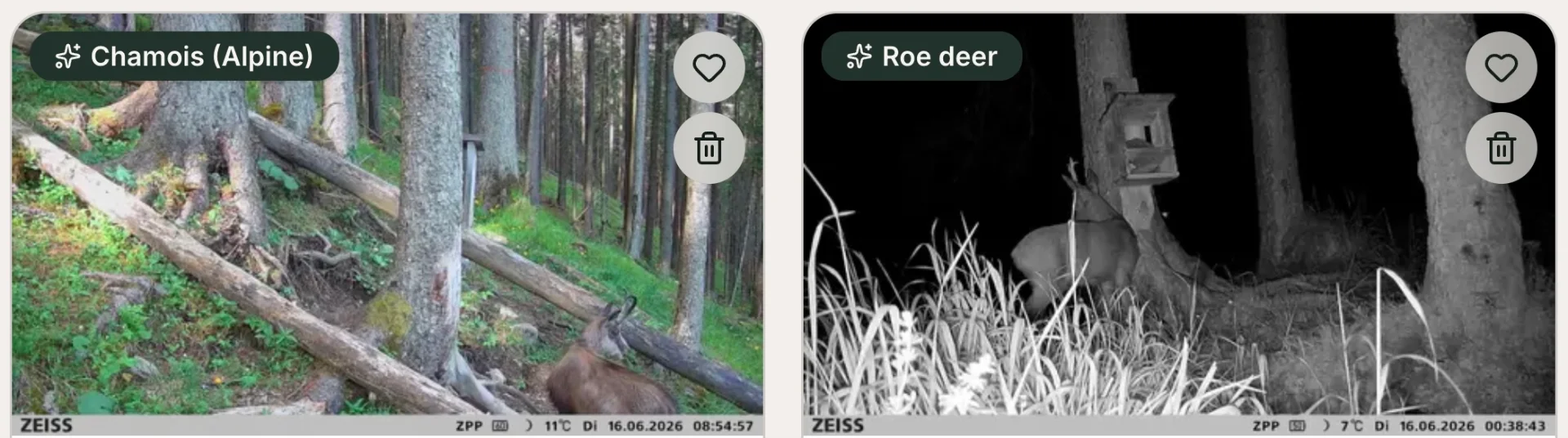
Every photo and video runs through a multi-step pipeline rather than a single black-box model. Each step uses a model built and proven specifically for wildlife camera-trap imagery, and the steps build on one another:
1. Detection — find the animals.
First we run MegaDetector, the standard open-source camera-trap detector created by Microsoft's AI-for-Earth program and used widely across wildlife research. It locates every animal, person and vehicle in the frame and draws a box around each — but it doesn't yet say which species. We drop low-confidence boxes and merge overlapping ones, so the same animal is never counted twice. If no animal is found, the photo is flagged as an empty/false trigger — that's how wind-in-the-grass shots get filtered out automatically.
2. Classification — identify the species.
Each detected animal is then passed to a species classifier, and which one we use depends on where your camera is:
In Europe — DeepFaune: a classifier from the French DeepFaune initiative, a CNRS-led collaboration of 50+ wildlife research and management partners, trained on a large European camera-trap dataset with an emphasis on the mammals common across Europe.
Worldwide — SpeciesNet: Google's open-source model (the one used in the Wildlife Insights platform). It pairs MegaDetector with an EfficientNet-V2 classifier trained on a very large global dataset covering 2,000+ species and higher-level groups.
3. Region tuning — narrow it to what actually lives where you hunt.
A worldwide classifier will occasionally propose a species that doesn't occur on your ground. We cut that down two ways:
Your game-species list: in your settings you choose the species you expect on your ground. We don't retrain the models on your photos — instead we use your list to validate each result. Anything that falls outside your list isn't silently accepted or relabelled; it's kept and flagged for review, so you stay in control and can confirm or correct it. The more accurately your list and camera location reflect reality, the cleaner your results.
4. Antler check (optional, for the deer species you enable).
For the antlered species you turn on, a separate vision-language model takes a close-up of the animal's head and judges whether antlers are visible. It's deliberately conservative: only a clear "yes" marks the animal as a likely male, uncertain cases go to needs review, and a missing or hidden antler never implies "female" — does, cast antlers, a turned head, or a head cropped out of frame simply can't be judged. To give this step a fair chance, we expand the crop upward so the head is included even when the detector framed only the body.
5. Result.
Per photo you get: the species, how many animals, a box on the image showing what was found and where, an antler/sex hint where it applies, and any people or vehicles marked (which can be blurred or hidden for privacy). Videos work the same way — we sample frames across the clip and combine the findings.
A note on accuracy: These are excellent, conservation-grade models, but no automated recognition is perfect — light, distance, motion blur, partial bodies and odd angles all make mistakes possible. Treat the results as a fast, powerful first pass rather than a guarantee, and verify anything that matters. The needs review flag exists precisely so the uncertain cases surface instead of hiding.